


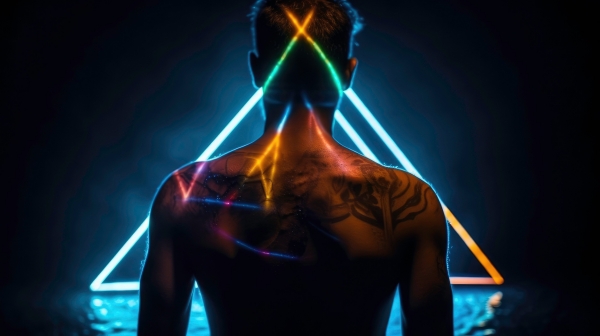
Recently, forest fires in northeastern Ontario and Quebec created haze and smoke in my little corner of paradise. One day it was so bad that I could feel my throat burning even in the sanctuary of my car. Events like this make me wonder what the world will be like in a hundred years. One of my goals in my Modified Humans series is to explore one possible future.
Modified Humans — their origins
In my fictitious future version of the world, a gentech company, Heredis Corporation, tries to create Modified Humans (GMH, or ‘Modifieds’) with superior immune systems. Heredis (“HCo’) then harvests their immune systems to save wealthy people from the terrible diseases that swept the globe during the 21st and early 22nd centuries.
Modified Humans — their attributes
In a physical sense, my Modifieds represent the very best of humanity. HCO stitched their genome together one base-pair at a time to create people who are more resistant to disease. They’re also beautiful, more intelligent, more long-lived, more ‘everything’ than your average person, whom my Modifieds refer to as ‘Normals’.
In this future world, the process of creating a Modified is exacting and difficult, therefore only a handful of them exist, making them ultra-valuable. However, not all of them exhibit the hoped-for enhanced immune systems. Therefore the few that do are especially highly prized.
Modified Humans — how they’re controlled
How do their makers ensure that Modifieds don’t outsmart and outmuscle everyone, and take over the world – or at least, take off to live independent lives? Answer: by controlling them through sophisticated brainwashing, which in my books is referred to as ‘conditioning’. To all appearances, Modifieds live privileged, glamorous lives, but in reality, they’re compliant slaves.
The writer’s perspective on writing about Modifieds
As a writer, I feel compelled to base my stories within the realm of scientific plausibility. For example, the idea of stitching a genome together, one base pair at a time, is (at present, anyway) scientifically impossible. However, the idea sounds possible. As for the idea of brainwashing, I must admit that it’s far outside my area of expertise – my background is in analytical chemistry and biomedical sciences, not psychology – but it seems to me that each one of us is the product of a lifetime of conditioning. Imagine, for example, having to stand, naked, in front of a thousand people, and deliver a speech. The stakes would have to be pretty high for most of us to even try to overcome that particular constraint.
Besides being scientifically plausible, my stories are about people. I love to explore my characters’ inner lives. I put them into difficult situations that force them to grow and change. I try to create believable societies for them to live in.
If you’re the kind of reader who enjoys relatable characters, believable societies, and stories filled with action, adventure, love, and even a little bit of sex, I hope you’ll give my Modified Humans series a try!