

In January of this year (2019), teenage climate-change activist GretaThunberg spoke at the annual meeting of the World Economic Forum in Davos, Switzerland. This is how she ended her speech: “I often hear adults say: ‘We owe it to the young people to give them hope. But I don’t want your hope. I don’t want you to be hopeful. I want you to panic. I want you to feel the fear I feel every day. And then want you to act. I want you to act as you would in a crisis. I want you to act as if the house is on fire. Because it is.”
This passionate young woman made me realize how little I knew about the science of climate change and global warming. This was reinforced when I had lunch with a friend who scoffed at the idea of a carbon tax; I didn’t have the hard facts to dispute her, only a conviction that she was wrong. So, because of Greta Thunberg, and because of my friend, I decided to educate myself. In this post, I want to review three books that have helped me to understand why we should panic.
Climate Change Book Review 1
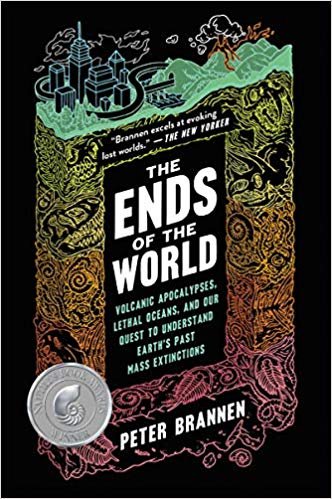
The first is The Ends of the World – Supervolcanoes, Lethal Oceans, and the Quest to Understand Earth’s Past Mass Extinctions.
Published in 2017, this book focuses on Planet Earth’s five previous mass extinctions. Written by award-winning science journalist Peter Brannen, it takes us on a fascinating journey to fossil sites all over the world. It introduces us to the people who study these fossils. And it explains their findings.By shedding light on the flora, fauna, and environmental conditions of the deep past–tens and hundreds of millions of years ago–and by explaining, in simple language, the basics of geochemistry and atmospheric science, Ends of the World helps us to understand how, on five separate occasions, life on the planet nearly disappeared. In each case, atmospheric carbon dioxide levels played a role. In each case, life managed to claw its way back from the brink, and to adapt to a changed world.
The book finishes by describing the sixth mass extinction which is unfolding now, and which is caused by the fastest release of carbon dioxide into the atmosphere the planet has ever seen. In the context of earlier mass extinctions, it’s all too easy to see where we might be headed.
Climate Change Book Review 2
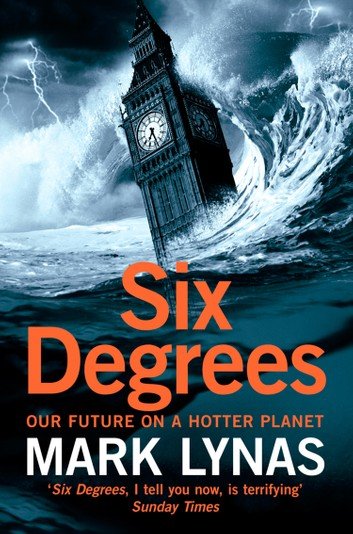
The next book is Six Degrees: Our Future on a Hotter Planet.This book was published in 2007 and so is a little out of date, in that it doesn’t account for the climate trajectory of the past twelve years. Nevertheless, the science in Six Degrees remains completely relevant. Written by journalist Mark Lynas, this book won the Royal Society Science Book Prize in 2008. (This prize is awarded for science books written for a lay audience, therefore Six Degrees is easy to read and understand.)
Referring to both the fossil record and climate models, Six Degrees examines the forces that will shape the world if global temperatures rise by 1 degree Centigrade above preindustrial levels (they already have), 2 degrees, and so on up to 6 degrees. The alarming news in this book is that, above 2 degrees of global warming, the warming process will become self-perpetuating as natural feedback cycles kick in. Human intervention will become irrelevant. Anyone who wants to understand why we need to panic, needs to read this book. If you don’t want to read the whole book, check out this short online summary
Climate Change Book Review 3
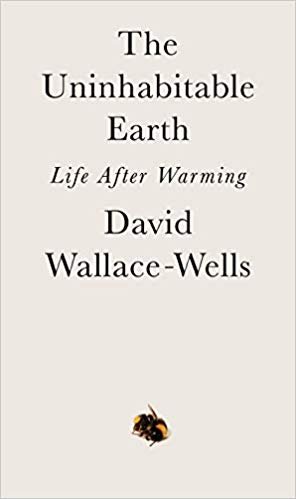
The final book I’ll mention is The Uninhabitable Earth: Life After Warming by David Wallace-Wells. Published earlier this year (2019), the book opens with, “It is worse, much worse, than you think.” Instead of breaking down climate change degree by degree, this book presents it under headings like, “Heat Death”, “Drowning”, “Hunger”, “Wildfire”, Unbreathable Air”. Reading Uninhabitable Earth in the wake of Six Degrees, I really started to get it. I was seeing how our world may end. Soon. If we don’t find a way to dramatically and quickly reduce carbon emissions, both the planet and human civilization could be unrecognizable by the end of this century. Imagine coastlines and cities disappearing under rising seas. Previously productive regions baked by drought. Hundred of millions of people displaced from their homes, wandering the globe in search of a place to settle. Armed conflict erupting everywhere. It’s almost too overwhelming to grasp.
I talked to friends about this. Most answered with variations of, “Yeah, but…”. Yeah, but other things will kill us long before climate change does.
Reactions to Climate Change
Yeah, but we’re not the worst offenders.
Some people retreated into fantasy land: “Carbon dioxide is a natural component of the atmosphere. It’s beneficial because it feeds plants. So, more carbon dioxide is good.”
Others shrugged fatalistically. “Nothing will happen till after I’m gone, so why should I care?”
The thing is, it’s already happening. Hurricane Dorian. The California wildfires. The June 2019 heat wave in Europe. People feel helpless because fixing climate change is beyond the scope of any individual person. So they choose to view these calamities as isolated events, not as warnings of worse to come. Collectively, we don’t want to relinquish our carbon footprint, so our elected governments don’t act. Yet without government co-ordination of efforts towards a mass solution, we’re like the frog in the slowly heating pot of water, eventually boiling to death as the world get hotter and hotter.
Climate Change in Fiction
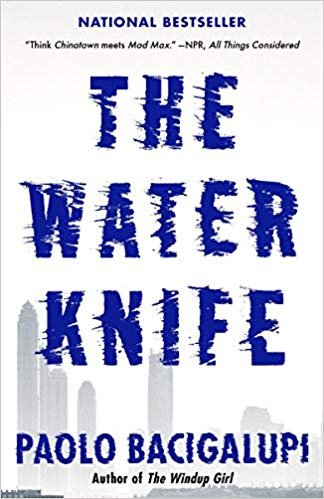
As a science fiction writer, I’m always looking for novels about climate change. An excellent one is author Paolo Bacigalupi’s The Water Knife. It’s a near-future story about the desertification of the American southwest, and the competition to control the water rights of the dwindling Colorado River. As a grim depiction of how bad things could get, the story is frighteningly plausible.
It’s interesting that I haven’t found any climate change stories that aren’t post-apocalyptic, dystopian tales. Maybe I just have to look harder.
All this has me taking another look at the books I’m working on. They’re set in Canada, one to two hundred years in the future. I hadn’t given much thought to global warming when I wrote the drafts. I think it’s time to go back and do some additional world-building. Perhaps to address a global problem like climate change, we need a global government? Hmmm…
LM Spilsbury note 2025
There remains a lot of controversy within the media as to whether humans have caused global warming. I think the evidence in favour is pretty overwhelming. In the years since I wrote this piece, we’ve experienced increasing numbers of wildfires, hurricanes, floods, and temperature swings in all seasons. The green movement to limit the amount of carbon dioxide being released into the atmosphere has gained strength. I can’t help but feel that it’s too little, too late.
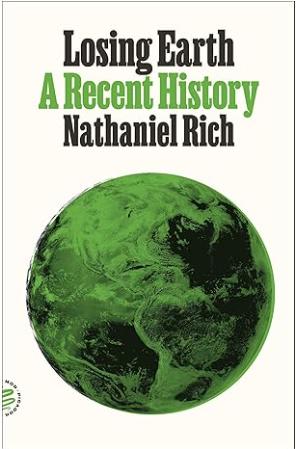
Nathaniel Rich’s book Losing Earth: A Recent History chronicles ‘the birth [in the 1980’s] of climate denialism and the genesis of the fossil fuel industry’s coordinated effort to thwart climate policy through misinformation propaganda and political influence’. If the move to limit fossil fuels had happened forty years ago, we’d be in much better shape now.