

When I First Started Writing
During the early years, much of my writing apprenticeship took place at the expense of a good night’s sleep. I’d awaken at 4am and write for three hours before tearing myself away to prepare for my day job at the lab. At the time, my husband and I lived in a small, shabby, 120-year-old duplex. My “office” was a tiny dormer room – a cupboard, really – with part of my desk extending under the slope of the roof into a space too cramped to stand in. At first I did my writing on a manual typewriter. Some of the keys were broken. The “o”s, for example, looked like “c”s, resulting in some very odd sentences. “The horses munched cats” has a very different meaning from “The horses munched oats”.
When I graduated to an electric typewriter, I could hardly believe my new writing speed. No more pounding on the keys! But that didn’t hold a candle to my first computer. It was a grindingly slow computer by today’s standards. I’d turn it on and then go away to prepare my breakfast while it booted. But I didn’t mind. Because now I could cut and paste – wow! – and I could correct mistakes without having to re-type the whole page.
My Earliest Works
During those early years, my writing was all about word-smithing – stringing words together in a pleasing fashion. This opening sequence for one of my early science fiction stories is an example:
I thought at first that she was a man.
I don’t know how long she’d been watching us when I first noticed her. It was one of those hot days when the distance seemed to shiver with haze, and the insects hummed and shrilled in the wheat, and there wasn’t a breath of wind to stir the tall dry stalks. I was pitching sheaves into the wagon and Davin was arranging them carefully, building the load with all the skill and care of a mason constructing a wall.
We didn’t talk. At best Davin offered a grunt. I didn’t really mind. I’d gotten used to it. I tossed the last sheaf up to him and began to lead the patient mare to the next shock down the row. That was when I saw the girl.
She looked like a man. She was dressed in leather breeches and tall leather boots. A broad-brimmed hat shaded her face. She was mounted on a bay stallion, and even with the field’s breadth between us I could tell that it was one of the fine riding horses they breed in the high valleys of County Bre in the north. Around her stretched the neat rows of newly stacked wheat. She seemed to be debating whether to trek all the way to the reapers in the distance or to choose the wagon where Davin and I gaped.
I never made it past the opening chapter on this one. Even so, I still enjoyed reading it when I recently unearthed it in my old files. Something about sunlight and horses has always resonated with me.
It’s Always Been Science Fiction and Horses
I can hear you asking: horses in science fiction?
Well, I seem to recall the setting was going to be a lost colony world. Since my real-life expertise didn’t lie in engineering or robotics or space physics, I focused on the things I knew. My undergraduate degree was in agricultural science, so before forging these paragraphs, I read up on how wheat was harvested by hand in the olden days.
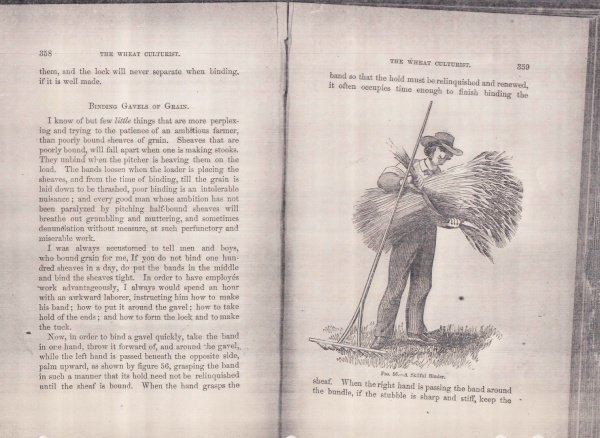
Because I worked at the University of Guelph, home of the Ontario Agricultural College, the library stacks actually contained the needed information. It came in the form of a musty old book published in 1868, “The Wheat Culturist”.
Because the mysteries of fashioning a story were still beyond my grasp, I gushed about horses, sunlight and summer heat, and made sure the technicalities of manual wheat harvesting were correct.
I didn’t have the faintest idea who “I” or Davin or the girl were, and I didn’t know why the girl-who-looked-like-a-man was riding in on a horse.
I didn’t know anything about this would-be world, except that the characters harvested wheat by hand, and in the north was a place called County Bre, and there were a lot of horses.
And I knew nothing about the elements of storytelling: the inciting incident, dramatic conflict, pinch points and all the rest.
But that was then. Now, I may be able to use those orphan paragraphs. With a nip here and a tweak there, they could fit nicely into an updated version that science fiction story.
I’ll add it to my list of projects.